The Best Second Passport for Crypto Investors in 2026
Malta is closed, Vanuatu lost Schengen, CARF is live. The honest 2026 guide to second passports for crypto investors: real costs, real tax rules, and the 10 programmes still worth considering.

The World That Ended in 2025
If you had asked this question in 2021, the answer would have been easy: buy a Caribbean passport for $100,000, move to Portugal, pay nothing on your gains, and get on with your life. That world is gone.
In the last eighteen months, three things rewrote the entire playbook. The European Court of Justice shut down Malta's golden passport programme — the last route to an EU passport through investment. The EU permanently stripped Vanuatu of visa-free Schengen access. And on 1 January 2026, the OECD's Crypto-Asset Reporting Framework (CARF) went live, meaning your exchange now collects your transaction data and hands it to tax authorities.
So this is not a shopping list. It is a strategy guide for a market that has become smaller, more expensive, and considerably more scrutinised. And here is the single most important thing to understand before you spend a dollar: a second passport does not, by itself, change your tax bill. Citizenship and tax residency are two different legal statuses. Getting this wrong is how crypto investors end up with a $250,000 document and an unchanged tax liability.
What a second passport does give you is optionality — the legal right to live somewhere else, bank somewhere else, travel without visa applications, and structure your affairs across more than one jurisdiction. For someone whose net worth sits in a volatile, politically contested asset class, that optionality has real value. If you want a personalised read on which of these routes your profile actually opens, start with a free eligibility assessment — it costs nothing and comes back in writing within 24 hours.
Key Takeaways
- Malta is closed. The CJEU ruled its citizenship-by-investment scheme illegal in April 2025 (Case C-181/23). No EU member state sells citizenship in 2026.
- Caribbean programmes start at $200,000 after the OECS minimum-price agreement of July 2024. Dominica is the cheapest; St. Kitts & Nevis is the strongest passport.
- El Salvador is the only programme that accepts Bitcoin directly — $1,000,000 in BTC or USDT, capped at 1,000 applicants per year.
- Vanuatu lost Schengen and UK access. Fast and cheap, but no longer a mobility play — read our full Vanuatu analysis.
- CARF and DAC8 are live: reporting began 1 January 2026, first exchanges in 2027. Anonymity is not on the menu.
- Citizenship ≠ tax residency. Buying a passport does not end your tax obligations at home, and US citizens are taxed on worldwide income regardless of where they live.
Why Crypto Investors Need a Second Passport in 2026
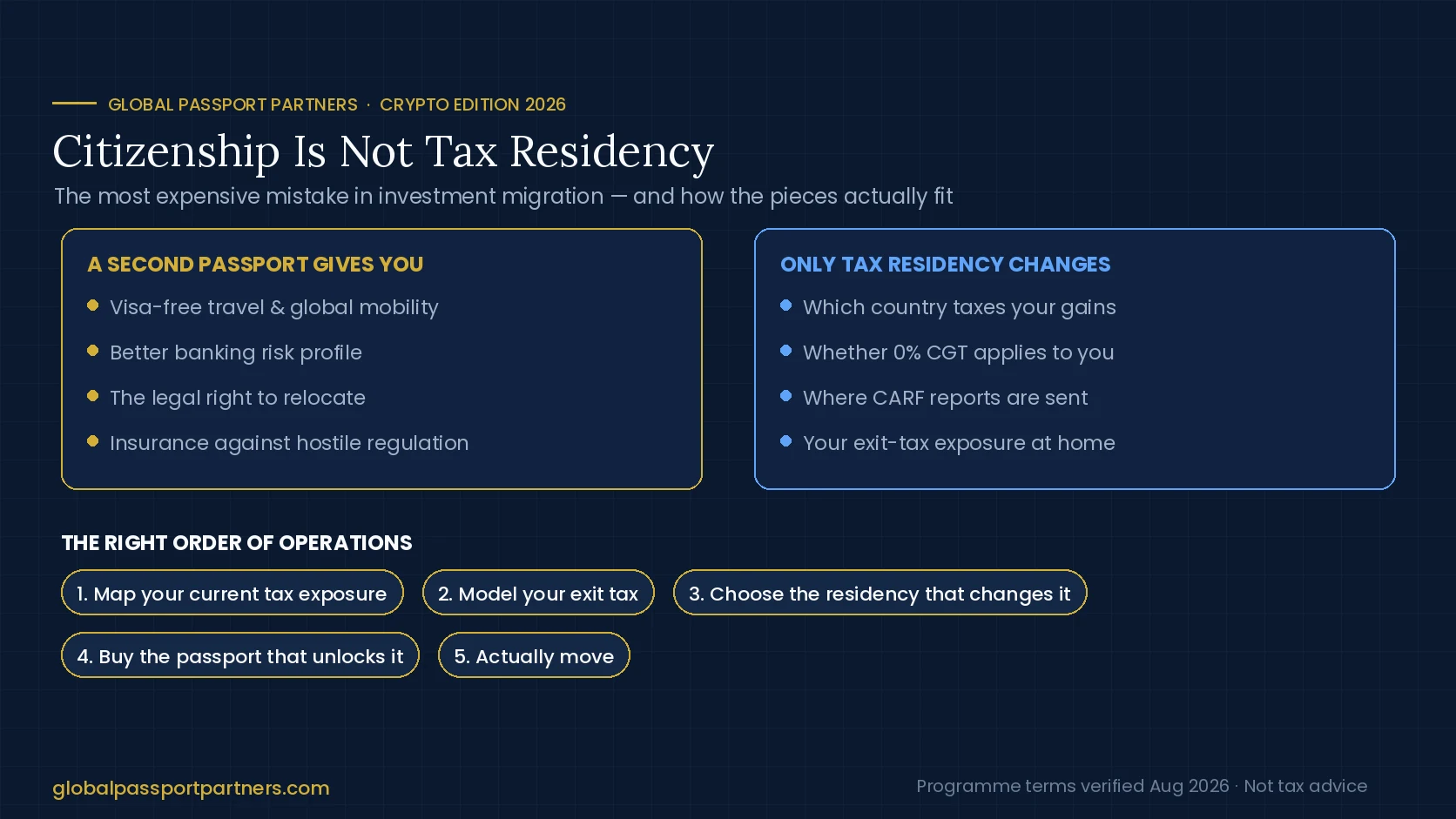
Tax optimisation is where most people start — and where most bad advice lives. A second passport does not reduce your taxes; changing your tax residency might. You can hold a Grenadian passport and still be a full UK tax resident paying UK rates on your gains, because tax residency follows where you actually live and where your centre of life sits — not which passports are in your drawer. Where the passport helps is that it gives you the legal right to relocate to a jurisdiction that treats your gains differently.
For one group, the passport is the whole strategy: US citizens. America taxes its citizens on worldwide income no matter where they live. The only complete exit is renouncing citizenship — which is legally impossible without another nationality first, and which triggers a substantial exit tax. Serious decision, specialist advice required, but the second passport is the non-negotiable first step.
Banking access is the most underrated reason — and in practice the one that pushes most crypto investors over the line. If you have tried to move a seven-figure sum from an exchange into a bank account, you know: compliance departments treat crypto proceeds as high-risk by default, accounts freeze mid-transfer, and relationships get terminated with thirty days' notice. Passport nationality is a direct input into every bank's risk scoring. It does not exempt you from KYC — it changes which pile your file lands in.
Then there is mobility itself. Web3 is a conference-driven industry; if your passport needs a visa application for Singapore, Dubai, London and Schengen, you are structurally disadvantaged against competitors who can book a Tuesday flight for a Thursday meeting. For holders of passports ranked outside the top fifty, a Caribbean citizenship can take visa-free access from roughly thirty destinations to over 150. Add jurisdictional diversification — capital controls, asset freezes and regulatory reversals all happen at the national level — and political insurance for an asset class where positions reverse in a single election cycle, and the case makes itself.
One sequencing rule before everything else: do not buy a passport to solve a tax problem you have not yet defined. First establish your actual exposure, then determine which residency changes it, then acquire the citizenship that makes that residency possible. Investors who reverse this order routinely spend six figures and change nothing.
What Makes a Country Crypto-Friendly?
'Crypto friendly' gets used loosely. Seven factors actually matter, roughly in this order:
- Capital gains treatment — several jurisdictions (UAE, Cayman, and every Caribbean CBI country) tax nothing; Portugal and Germany exempt only holdings over 12 months; and the investor-versus-trader line is the trap everywhere — systematic trading gets recharacterised as business income.
- Regulatory clarity — boring, defined rules (UAE's VARA, Singapore, Switzerland, EU MiCA) beat generous but ambiguous ones, because ambiguity means retroactive risk.
- Banking support — will a bank there actually onboard crypto-derived wealth? Zero-tax Caribbean nations often have cautious domestic banking; the UAE and Switzerland tax more but bank better. Verify before you commit.
- Residency options and presence rules — a passport you can never use is a poor investment; check the days needed to claim (or avoid) tax residency, usually 183.
- Political and economic stability — programmes get suspended and passports get downgraded; Vanuatu holders learned this the hard way.
- Passport strength — tracked by the Henley Passport Index; treat any specific number as a snapshot, not a permanent feature.
- Dual-citizenship policy — most CBI countries permit it, but India, China and others require renunciation. This is binary and can end the conversation; Indian readers should start with our India-specific guide.
The 10 Programmes at a Glance
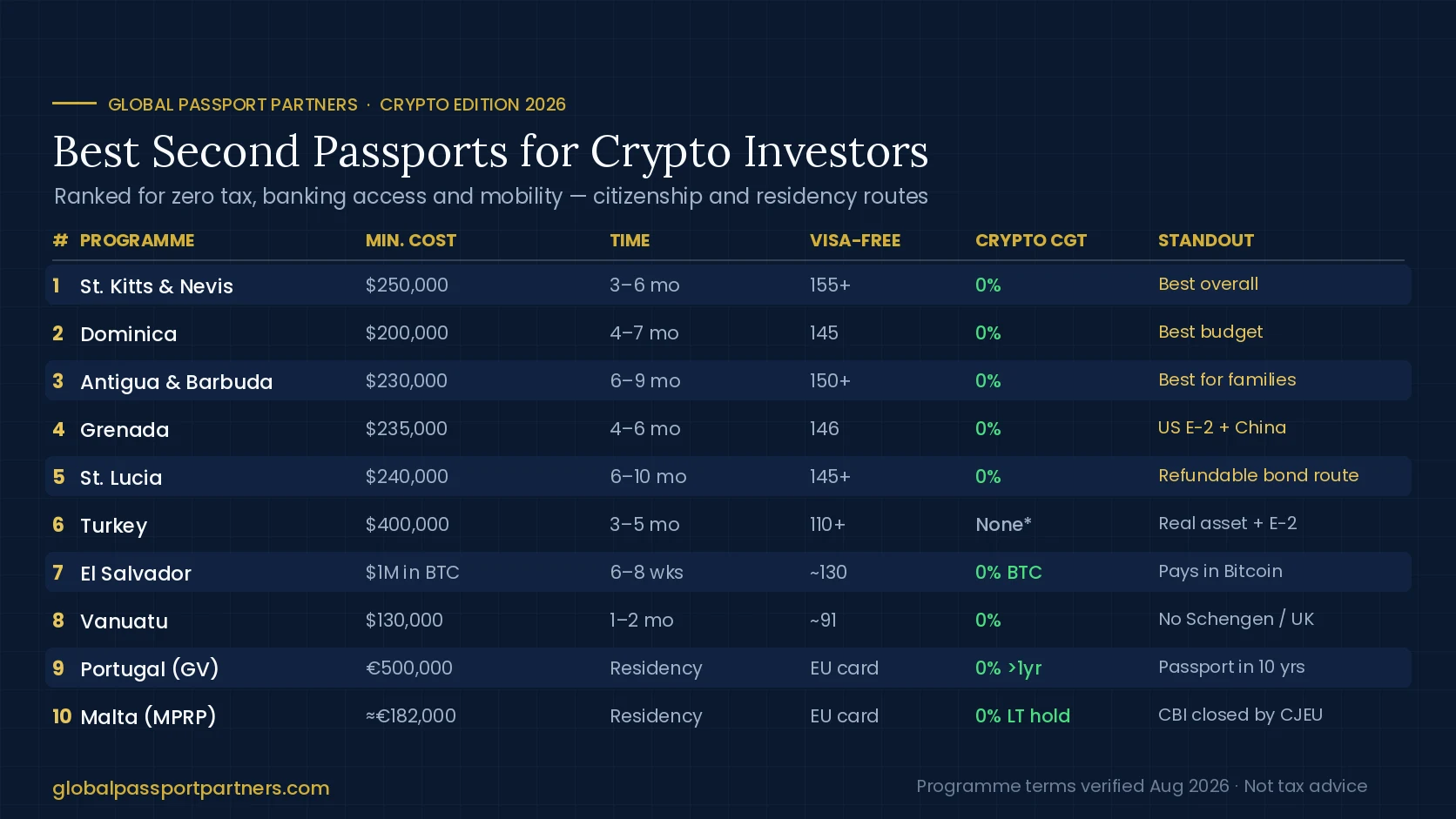
All figures reflect published programme terms as of August 2026 — verify with the official government unit before committing funds. Full side-by-side data for every programme we operate lives on our comparison page.
| Programme | Min. Investment | Processing | Visa-Free | Crypto CGT | Standout |
|---|---|---|---|---|---|
| St. Kitts & Nevis | $250,000 | 3–6 months | 155+ | 0% | Strongest Caribbean passport |
| Dominica | $200,000 | 4–7 months | 145 | 0% | Lowest price with Schengen |
| Antigua & Barbuda | $230,000 | 6–9 months | 150+ | 0% | Best for large families |
| Grenada | $235,000 | 4–6 months | 146 | 0% | US E-2 treaty + China access |
| St. Lucia | $240,000 | 6–10 months | 145+ | 0% | Refundable bond option |
| Turkey | $400,000 | 3–5 months | 110+ | None (no specific CGT) | Real asset + E-2 |
| El Salvador | $1,000,000 in BTC/USDT | 6–8 weeks | ~130 | 0% on Bitcoin | Only programme paid in crypto |
| Vanuatu | $130,000 | 1–2 months | ~91 | 0% | Fastest — but no Schengen/UK |
| Portugal (Golden Visa) | €500,000 funds | 12–24 months (permit) | EU residence | 0% if held >365 days | EU passport in 10 years |
| Malta (MPRP) | ≈€182,000 all-in | 6–8 months (residence) | EU residence | 0% long-term holdings | CBI closed — residence only |
1. St. Kitts & Nevis — The Benchmark
Home to the world's oldest citizenship-by-investment programme (1984), St. Kitts delivers the strongest Caribbean passport at roughly 155+ visa-free destinations, 3–6 month processing, and a $250,000 Sustainable Island State Contribution (real estate from $325,000). No personal income, capital gains, inheritance or wealth tax — though citizenship alone does not make you tax resident; you would need to actually establish residence to benefit.
The crypto position is neutral: no hostile regulation, no purpose-built framework, and conservative domestic banking — plan to bank internationally, where the passport genuinely helps. Bonus for wealth protection: Nevis is a long-established asset-protection jurisdiction with strong LLC and trust legislation. A real-world pattern we see constantly: a DeFi founder on a weak passport turns every investor meeting into a visa application; with St. Kitts, Schengen, the UK and Singapore open visa-free, and the fundraise runs on his calendar instead of a consulate's. Full details on our St. Kitts programme page.
2. Dominica — The Budget Entry
Dominica has run its programme since 1993 and remains the lowest-cost route to a legitimate Caribbean passport: $200,000 to the Economic Diversification Fund, 4–7 months including the mandatory interview, and visa-free access to 145 destinations including Schengen (the UK withdrew access in 2023). No capital gains, wealth or inheritance tax, territorial system for non-residents.
No dedicated crypto framework — treat Dominica's exchange-partnership headlines as signals of openness, not a regulatory regime. Weakest passport of the Caribbean five, smallest banking infrastructure, unbeatable price. Compare it directly with its peers in St. Kitts vs Dominica vs Grenada or see our Dominica programme page.
3. Antigua & Barbuda — The Family Option
Antigua's passport hit a record high in the 2026 Henley Index (~150+ destinations, rank 24) and its family mathematics are untouchable: $230,000 NDF for a family of four, or the $260,000 University of the West Indies Fund for six or more people — including a year of tuition for one family member. Dependant eligibility is the widest in the industry: spouse, children under 31, unmarried siblings, parents and grandparents 55+.
The one obligation is 5 days of physical presence within the first five years — the only Caribbean programme requiring a visit. We recently modelled a fund manager moving himself, his wife, three children and both sets of parents out of a tightening capital-controls jurisdiction: per-dependant fees would have pushed most programmes past $400,000; the UWI route brought the qualifying contribution to $260,000 before fees. Details on our Antigua & Barbuda page.
4. Grenada — The US Access Play
Grenada's $235,000 National Transformation Fund contribution (family of four included) buys the Caribbean's most strategic passport: it is the only CBI country holding a US E-2 Treaty — making citizens eligible to apply for the renewable E-2 Investor visa and live in America by investing in a US business — plus rare visa-free access to China. Processing runs 4–6 months, and the zero-tax profile matches its peers.
One caveat that matters in 2026: US authorities increasingly expect E-2 applicants who bought citizenship to show genuine ties to Grenada, not merely a purchased document — plan for real substance. The full US strategy is mapped in our Grenada-to-E-2 route guide, and programme details are on our Grenada page.
5. St. Lucia — The Flexible Middle
The newest of the Caribbean five (2015) was built with lessons from the others: a $240,000 National Economic Fund route, plus the region's only $300,000 government bond option — non-interest-bearing but fully refundable after the holding period, meaning your net cost is limited to fees. Processing runs 6–10 months; the passport reaches 145+ destinations including the UK and Schengen.
For a crypto investor who hates sunk donations, the bond structure is the standout: capital preserved, citizenship kept. The trade-off is a higher headline figure and slower processing. Full breakdown on our St. Lucia programme page.
6. Malta — Closed for Citizenship, Open for Residency
This is the most important entry in the article, because most competing guides still list Malta as a purchasable EU passport. It is not. On 29 April 2025, the Court of Justice of the European Union ruled in Case C-181/23 that Malta's investor citizenship scheme breached EU law; Malta ended the programme by Act XXI of 2025. Cyprus closed in 2020, Bulgaria in 2022 — no EU member state offers citizenship by investment in 2026, and anyone selling you one is a red flag with a website.
What remains is genuinely useful: the Malta Permanent Residence Programme grants lifetime EU permanent residence (a card, not a passport) from roughly €182,000 all-in on the lease route. For crypto specifically, Malta is one of Europe's most sophisticated jurisdictions: long-term holdings treated as a store of value are untaxed, professional trading is taxed as income up to 35%, and the non-dom regime taxes foreign income only on remittance. Buy Malta for residence and tax positioning under MiCA-grade regulatory clarity — not for a passport. Full details on our Malta MPRP page.
7. Turkey — The Large-Country Option
Turkey is the only programme here attached to a G20 economy: $400,000 into real estate you actually own (3-year hold) or $500,000 in deposits or funds, citizenship in 3–5 months, spouse and under-18 children included, plus US E-2 treaty access. The crypto context is unusual — one of the world's highest adoption rates, a developing exchange-licensing regime, CARF committed for 2028, and no specific individual crypto capital gains tax, though that has been debated repeatedly and should not be assumed permanent.
During 2026 Turkey also advanced a tax package aimed at relocating wealth — reported multi-year exemptions on foreign-source income for qualifying new residents — but treat these as developing measures and verify with Turkish counsel before relying on them. Two structural warnings: no Schengen visa-free access, and citizenship-market real estate is routinely priced above market value. Commission an independent valuation from an appraiser you selected — the valuation must independently clear $400,000 or the application fails regardless of what you paid. Our full due-diligence process is on the Turkey programme page and in our Turkish real estate guide.
8. Vanuatu — Fast, Cheap, and Much Weaker Than Advertised
Vanuatu remains the fastest citizenship on earth — 1–2 months, $130,000 single applicant, fully remote — and a genuine zero-tax jurisdiction with an explicit Virtual Asset Service Providers licensing regime. But any marketing claiming 110+ destinations or European access is outdated: the EU fully suspended Schengen access in February 2023 and permanently moved Vanuatu to the visa-required list in December 2024 (Regulation (EU) 2025/11), explicitly because of the passport programme. The UK followed in July 2023, and long-term US visas stopped being issued to Vanuatu citizens in January 2026.
The two destinations most buyers actually want are precisely the two this passport no longer opens. Vanuatu now suits one profile only: an investor who wants a genuine zero-tax base or an emergency backup document quickly and cheaply — explicitly not a mobility play. We wrote the full post-mortem in Vanuatu after the Schengen loss, and if budget is the driver, compare it against every credible option under $150K.
9. Portugal Golden Visa — The Long Game, Now Longer
Portugal is residency, not citizenship — and the distance between the two just doubled. The revised Nationality Law (promulgated 3 May 2026, applying from 19 May 2026) extends naturalisation from five years to ten for most nationalities (seven for EU/CPLP), with the clock starting from your first residence card. The Golden Visa itself is unchanged: €500,000 into CMVM-regulated funds (real estate was removed in 2023), 7 days' presence in year one and 14 per subsequent two-year period, family included.
The crypto rules remain among Europe's best for patient holders: gains on assets held over 365 days are exempt for individual non-traders, crypto-to-crypto swaps are generally not taxable disposals, and shorter holds pay a flat 28%. Professional trading is taxed as business income — the investor/trader line matters here more than anywhere. Golden Visa holders do not become tax residents unless they actually relocate; 7 days is nowhere near the 183-day threshold. Buy Portugal for EU residence, fund diversification and a decade-long passport endgame — not a fast document. Full analysis on our Portugal page and in Portugal vs Greece.
10. El Salvador — The Only Programme That Takes Bitcoin
Every other programme requires converting crypto to fiat, moving it through banking, and surviving a compliance review — the exact point where large crypto transactions most often fail. El Salvador's Freedom Visa is structurally unique: the $1,000,000 qualifying contribution is paid directly in BTC or USDT to a government wallet, on-chain, with citizenship in 6–8 weeks, fully remote, capped at 1,000 applicants a year. Schengen access (~130 destinations), US E-2 treaty, zero capital gains on Bitcoin, territorial taxation — and a notable long-term door: Salvadoran citizens can apply for Spanish citizenship after just two years of legal residence in Spain.
The honest caveats: it costs four to five times a Caribbean passport; the contribution is non-refundable; indefinite presidential re-election was approved in July 2025, concentrating political risk; and the programme is young. One more trap — paying on-chain may still be a taxable disposal in your home jurisdiction, depending on your residency at the moment of payment. That analysis comes first, not after. For a Bitcoin-native founder whose entire balance sheet is on-chain and whose banking is the bottleneck, this is the only programme designed for that reality.
Ranked by What Actually Matters to a Crypto Holder
Passport strength alone is the wrong ranking. For a pure zero-tax base: Vanuatu and El Salvador lead, with all five Caribbean programmes effectively equal at 0%, Turkey untaxed but under review, and Portugal exempt only past 365 days. For banking access: Malta and Portugal (EU institutions with real digital-asset competence), then Turkey's large crypto-literate sector — while Caribbean passports help your international onboarding more than their domestic banks ever will. Plan to bank in a third jurisdiction in every scenario.
For lifestyle: Portugal is the strongest quality-of-life case on this list, Malta close behind, Istanbul underrated; the islands are beautiful and limited; El Salvador and Vanuatu suit a specific temperament. For regulatory clarity: Malta and Portugal under MiCA, then Vanuatu's explicit VASP statute, with the Caribbean permissively unregulated — no hostility, but no positive certainty either. For wealth protection: Nevis's trust and LLC legislation makes St. Kitts the standout, with Antigua second and EU-grade legal certainty in Malta and Portugal behind them. Not sure where your profile lands? Take the 2-minute quiz and get your top three matches scored.
Tax: The Part Most Guides Get Wrong
Say it out loud: acquiring a Grenadian passport does not make you a Grenadian tax resident. Tax residency is determined by physical presence — commonly 183 days — plus permanent-home, centre-of-vital-interests and habitual-abode tests, with treaties resolving conflicts in that tie-breaker sequence. Buy a Caribbean passport and keep living in Germany, and German rules still apply to your gains. Nothing changed except your travel options.
Know which system you are leaving and entering: worldwide taxation (most large economies) taxes residents on global income; territorial systems (Panama, Georgia, El Salvador, several Caribbean states) tax only local income; and citizenship-based taxation exists meaningfully only in the United States — Americans are taxed wherever they live, and only renunciation (which requires a second nationality first, plus an exit tax) changes that.
Exit tax deserves its own paragraph because for crypto investors it is often the single largest number in the plan. Canada, Australia, Germany, France and the US (for covered expatriates) all impose deemed-disposal charges when you cease residency — and a long-held position with a low cost basis generates an enormous deemed gain. Model your exit tax before you model anything else; the order of when you move, sell and establish new residency can swing the liability by seven figures.
And transparency has arrived: CRS has exchanged bank data since 2017, FATCA covers US persons, and CARF extends the same logic to crypto — collection began 1 January 2026, first domestic reports are due 2027, the EU implements it via DAC8, and the committed-jurisdiction list already spans the EU, UK, Canada, Japan and Korea with the UAE, Singapore, Switzerland and Turkey following and the US targeting 2029. Your exchange reports your identity and transactions to a tax authority, which shares them with the authority where you are resident. The era where a passport bought opacity is over; what it can legitimately do is change which authority receives the report — by genuinely changing where you live.
| Approach | Jurisdictions | Effect for Crypto |
|---|---|---|
| No CGT at all | Caribbean five, Vanuatu, El Salvador, UAE, Cayman | Gains untaxed for actual residents |
| Holding-period exemption | Portugal (365 days), Germany (12 months) | Long-term holders exempt; short-term taxed (28% flat in Portugal) |
| Store-of-value exemption | Malta | Long-term holdings exempt; professional trading up to 35% |
| No specific individual CGT | Turkey | Currently untaxed — but under periodic review |
Risks: Where This Industry Bites
Programme terms change with little notice — the Caribbean floor jumped to $200,000 in July 2024, Portugal doubled its naturalisation period in 2026, and Malta's programme was terminated by a court. Never build a plan that only works if rules stay static, and ask specifically what happens to your application if terms change mid-process. Counterintuitively, favour the programmes with the strictest vetting: the tougher the due diligence, the more durable the passport's value against EU and US pressure.
For crypto investors specifically, source of funds is the most common failure point. Expect to document exchange records, complete transaction histories, wallet addresses with on-chain verification, prior tax filings and the original fiat purchases. Wealth from early mining, peer-to-peer buys or dead exchanges is hardest to evidence — start assembling months before applying, because application fees are non-refundable on rejection and a refusal in one programme can surface in others' shared databases.
Investment routes carry market risk (Turkish property priced above market, Portuguese funds that can fall, illiquid Caribbean real estate), and citizenship obtained by misrepresentation can be revoked years later — complete disclosure is not optional. Finally, the scam checklist: any 'EU passport by investment' offer, any 'diplomatic passport', prices below published government minimums, payments to personal accounts instead of government escrow, guaranteed approvals, or an agent who will not name the licensed firm filing your case. Every legitimate programme publishes its authorised-agent list; check it.
How to Choose: Seven Filters in Order
Budget first — and budget properly: government fees ($10K–$50K), due diligence ($5K–$10K per adult), legal and agent fees, biometrics travel. A $200,000 Dominica application typically lands at $240,000–$270,000 all-in for a single applicant; plan 20–30% above any headline. Then count your family and compare per-person economics, not sticker price — Antigua's $260,000 for six people beats St. Kitts' $250,000 for one by a mile if you are bringing everyone.
Then business needs (US presence → Grenada or Turkey E-2; China → Grenada; EU operations → Portugal or Malta residency, because no CBI delivers it), then your genuine travel pattern (150 destinations mean nothing if they exclude the three cities you visit monthly), then tax — with the honest question: are you actually going to move? If yes, optimise for the residence and treat the passport as the enabler. If no, value it purely for mobility and banking, and do not pay a tax premium for a benefit you will not receive.
Lifestyle and the fifteen-year view come last but decide the tiebreaks: want your children holding EU citizenship? Portugal's ten-year path may still beat any Caribbean passport. Maximum flexibility now? Caribbean. Zero-tax base quickly? Vanuatu or El Salvador. The most common structuring error is treating this as one decision — sophisticated investors routinely combine a Caribbean passport for mobility, a separate tax residency in a territorial jurisdiction, and banking in a third country with strong institutions. Each element does one job well. Our advisors build exactly these multi-jurisdiction stacks — book a free assessment and we will map yours.
Final Verdict
Best overall: St. Kitts & Nevis — the strongest Caribbean passport, fastest reliable processing, forty years of credibility, zero capital gains tax, and the document that raises the fewest questions at a bank counter. Best budget: Dominica at $200,000, the lowest price that still opens Schengen. Best for families: Antigua & Barbuda, untouchable per-person mathematics. Best for entrepreneurs: Grenada or Turkey for E-2 access. Best pure tax bases: Vanuatu and El Salvador — if you genuinely relocate. Best for Web3 founders: El Salvador, the only programme built for an on-chain balance sheet.
The honest closing thought: passports are mobility instruments, banking instruments and insurance policies — not tax solutions. Tax outcomes come from residency, and residency comes from genuinely changing where you live. What changed in 2026 is that the gap between the marketing and the reality became impossible to ignore: Malta closed, Vanuatu grounded, Portugal a decade out, CARF watching. None of that makes a second citizenship less valuable — it makes it a different kind of valuable. Less about what you can hide; more about where you can legitimately go.
Start with your tax position. Model your exit cost. Then choose the passport that makes your plan possible — and if you want that mapped to your actual numbers, our free assessment puts a licensed advisor's written opinion in your inbox within 24 hours.
Frequently Asked Questions
Yes, in exactly one place. El Salvador's Freedom Visa accepts the full $1,000,000 qualifying contribution in BTC or USDT paid directly to a government wallet — the only programme in the world that does. Every other programme requires fiat, meaning conversion first and banking compliance on the source of funds.
Several: Vanuatu, the UAE, the Cayman Islands and all five Caribbean CBI nations impose no personal capital gains tax at all. El Salvador exempts Bitcoin specifically. Portugal and Germany are zero only past twelve months of holding. The catch in every case: you must become an actual tax resident to benefit — the passport alone does nothing.
It depends on your existing nationality, not the issuing country. Most CBI countries permit it, but India, China, Singapore, Japan and others require renunciation of your original nationality. Confirm your home country's position before anything else — it is binary and can end the conversation.
Among programmes available in 2026, St. Kitts & Nevis leads the Caribbean on visa-free access at roughly 155+ destinations, with Antigua & Barbuda close behind after climbing to rank 24 in the 2026 Henley Index. Both provide Schengen and UK access.
Vanuatu is fastest at 1–2 months; El Salvador runs 6–8 weeks. The Caribbean programmes take roughly 3–10 months, with St. Kitts fastest. Turkey runs 3–5 months. Portugal is not a citizenship programme at all — it is residency, with naturalisation now ten years away for most nationalities.
Yes, in every programme covered. Antigua & Barbuda is broadest: spouse, children under 31, unmarried siblings, and parents and grandparents 55+. Grenada also covers dependants of the spouse. Turkey and El Salvador are narrower — generally spouse and minor children.
Vanuatu at $130,000 is cheapest overall, but its passport lost Schengen and UK access. Among programmes retaining European access, Dominica at $200,000 is the lowest.
No. Malta was the last EU state selling citizenship, and the CJEU ruled it illegal in April 2025 (Case C-181/23). Cyprus closed in 2020, Bulgaria in 2022. Anyone offering an EU passport for investment in 2026 is either misinformed or fraudulent.
Not by itself. Tax liability follows tax residency — where you physically live and where your centre of life sits. A second passport gives you the legal right to relocate somewhere with better treatment, but until you actually move and properly exit your current residency, nothing changes.
Yes. CARF reporting is based on your tax residency, which crypto service providers determine through self-certification and documentation. A second passport does not exempt you; it may change which authority receives your data — but only if your actual tax residency changes.
The Crypto-Asset Reporting Framework is the OECD standard requiring crypto service providers to collect and report user transaction data to tax authorities, which exchange it internationally. Collection began 1 January 2026 for the first wave, with first reports due to domestic authorities in 2027. The EU implements it via DAC8.
Mostly no. St. Kitts, Dominica, Grenada, St. Lucia, Vanuatu and El Salvador require no residency. Antigua requires 5 days within the first five years. Turkey requires biometric visits. Portugal requires 7 days in year one and 14 per subsequent two-year period — far below any tax-residency threshold.
Yes — for material misrepresentation or non-disclosure at application. Several countries have retroactively revoked citizenship when due-diligence failures surfaced later. Complete, accurate disclosure is essential; an omission you consider minor can invalidate the citizenship years afterward.
If you can move fiat comfortably, St. Kitts & Nevis offers the best combination of mobility, speed and zero tax at $250,000. If your wealth is locked on-chain and banking conversion is the bottleneck, El Salvador's in-kind BTC payment solves a problem no other programme addresses — at four times the price.
Expect exchange statements, complete transaction histories, wallet addresses with on-chain verification, prior tax returns declaring the holdings, and records of the original fiat purchases. Early-mining and defunct-exchange wealth is hardest to document — assemble everything months before applying.
No. No Caribbean CBI passport provides visa-free entry to the US, Canada or Australia. Grenada uniquely offers eligibility to apply for the US E-2 Treaty Investor visa — a long-term residence route requiring a separate qualifying business investment in America.
The EU partially suspended visa-free access in March 2022, fully suspended it from February 2023, and permanently moved Vanuatu to the visa-required list on 12 December 2024. The UK imposed visa requirements in July 2023. Any marketing claiming Vanuatu opens Europe is outdated.
For the right profile, yes — but not as a passport play. It delivers EU residence without relocating, and Portugal exempts personal crypto gains on assets held over 365 days. Naturalisation now takes ten years for most nationalities under the law in force since 19 May 2026. Buy it for residence and tax positioning, not a fast EU passport.
Budget 20–30% above the headline investment. A $200,000 Dominica application typically totals $240,000–$270,000 for a single applicant once government fees, due diligence, legal fees and processing are included. Family applications scale with per-dependant due-diligence charges.
The calculation is different for Americans. The US taxes citizens on worldwide income regardless of residence, so a second passport provides no tax benefit while you remain American. Its value is as a prerequisite: you cannot renounce US citizenship without another nationality, and renunciation — with its substantial, irreversible exit tax — is the only route out of US worldwide taxation. Take specialist advice.