The Easiest Countries to Get Citizenship in 2026
Discover the easiest countries to get citizenship in 2026 through ancestry, investment, and naturalization. Compare timelines, costs, and requirements with verified data.

Why 'Easiest' Depends Entirely on You
Second citizenship is no longer a luxury reserved for the ultra-wealthy. In 2026, investors, digital nomads, ancestry holders and long-term residents have more pathways than ever to acquire a new nationality. Yet 'easiest' is a relative term. What is effortless for a person with Irish grandparents may be impossible for someone without European ancestry. What is fast for a high-net-worth investor may be unaffordable for a budget-conscious family.
This guide evaluates accessibility across ten dimensions — speed, cost, residency burden, documentation complexity, language requirements, ancestry availability, investment thresholds, dual-citizenship policy and process predictability. Every country listed has been verified against current legislation and official government sources as of August 2026.
What Makes a Country 'Easy' for Citizenship?
There is no universal easiest citizenship. A country is relatively accessible when it minimises the barriers most relevant to a specific applicant type. We score each jurisdiction against a transparent set of criteria:
- Speed: legal qualifying period plus realistic administrative processing time.
- Cost: government fees, investment minimums and professional-service costs.
- Residency burden: days per year required inside the country.
- Documentation complexity: birth certificates, apostilles, criminal records and financial evidence.
- Language requirements: mandatory tests versus exempt routes.
- Ancestry availability: generational depth allowed (parent, grandparent).
- Investment threshold: minimum capital outlay for investor programmes.
- Dual-citizenship policy: whether you can retain your original nationality.
- Predictability: clear legislative framework versus discretionary or court-based processes.
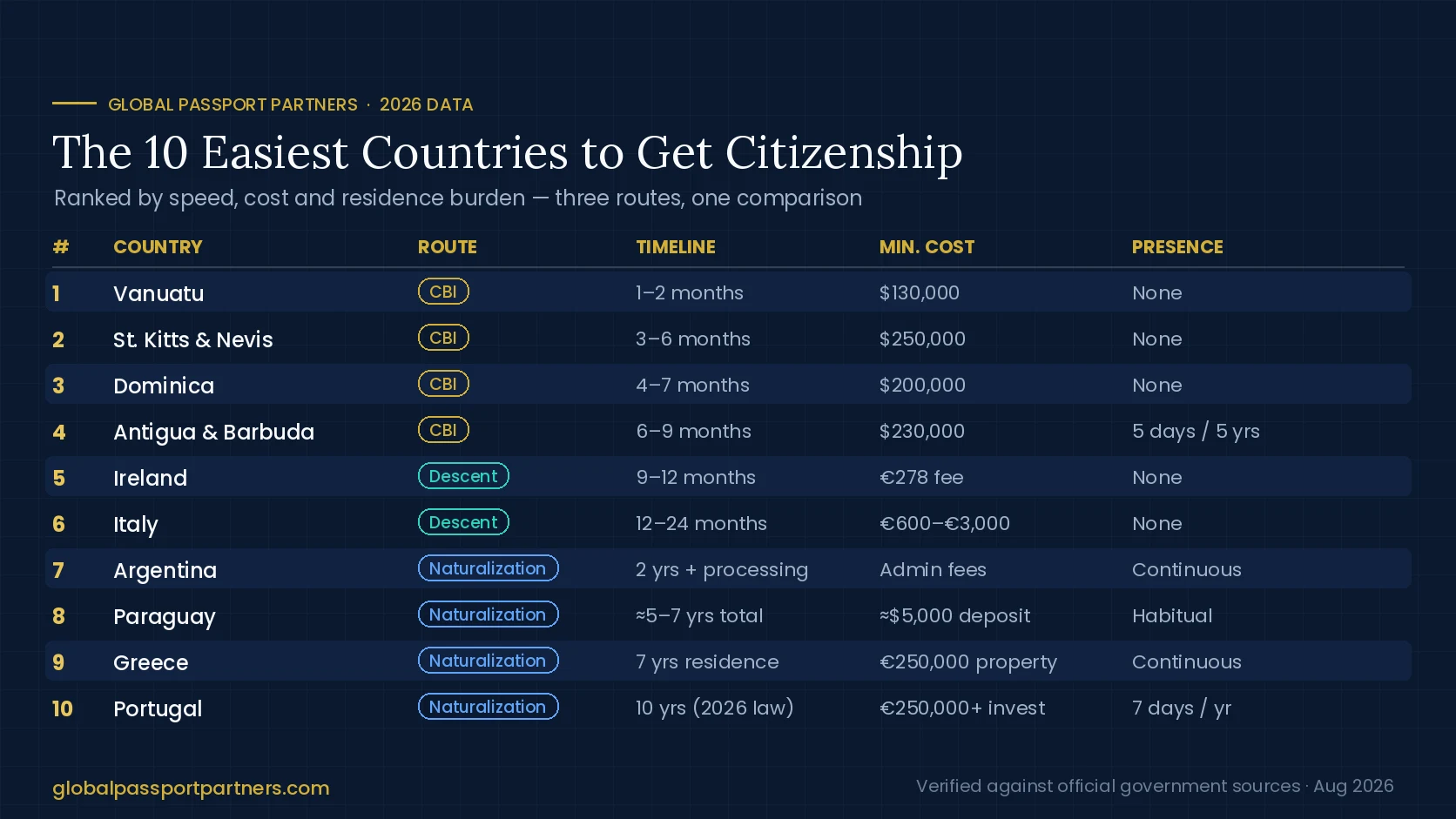
The 10 Easiest Countries in 2026 — Side by Side
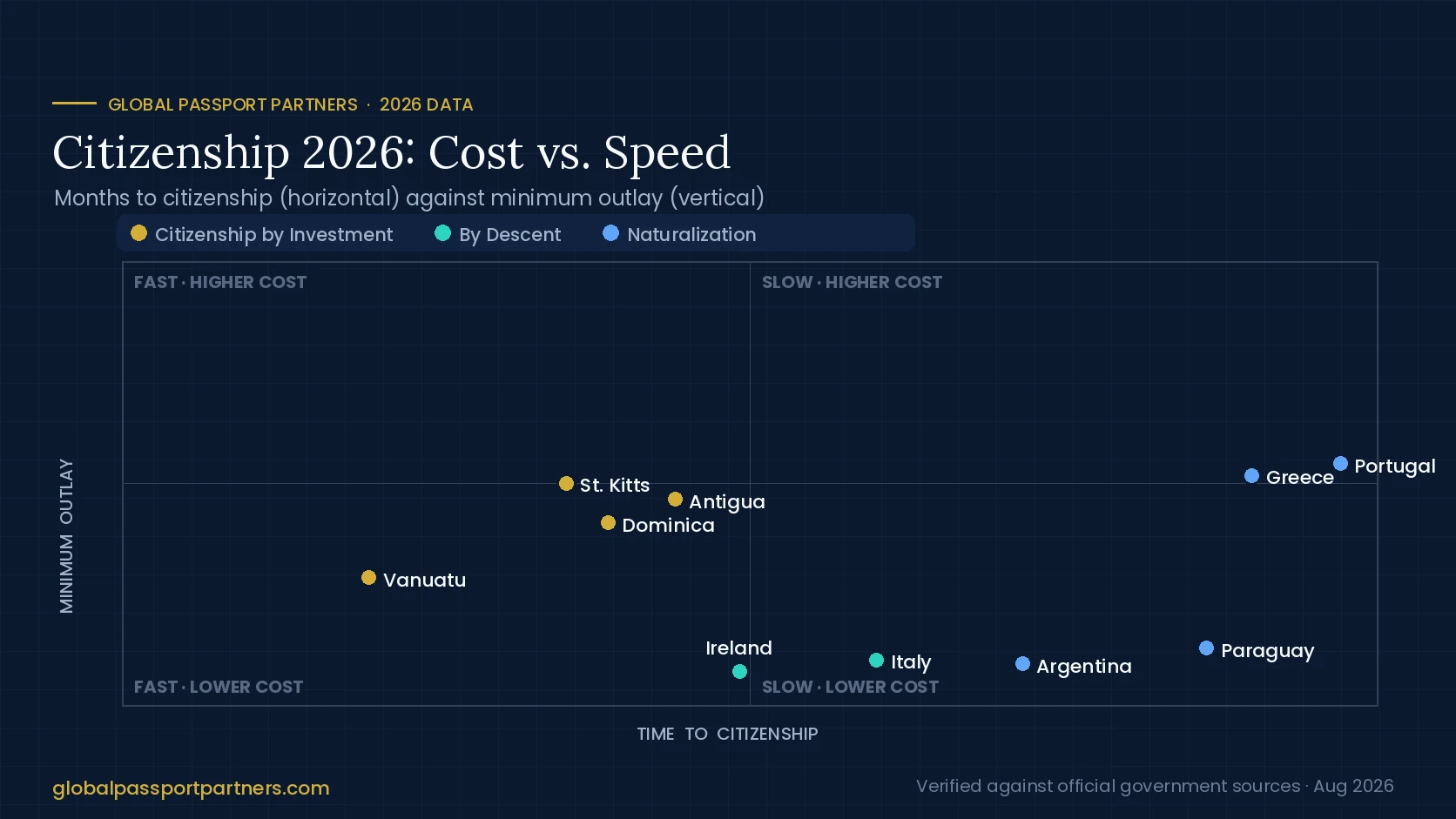
A route that scores highly on speed and low on residency burden may score poorly on cost. The comparison below balances all three routes — investment, descent and naturalisation — so you can match a country to your profile.
| Country | Route | Timeline | Presence | Min. Cost | Dual OK? |
|---|---|---|---|---|---|
| Vanuatu | CBI | 1–2 months | None | $130,000 | Generally no |
| St. Kitts & Nevis | CBI | 3–6 months | None | $250,000 | Yes |
| Dominica | CBI | 4–7 months | None | $200,000 | Yes |
| Antigua & Barbuda | CBI | 6–9 months | 5 days / 5 yrs | $230,000 | Yes |
| Ireland | Descent | 9–12 months | None | €278 fee | Yes |
| Italy | Descent | 12–24 months | None | €600–€3,000 | Yes |
| Argentina | Naturalisation | 2 yrs + processing | Continuous | Admin fees only | Yes |
| Paraguay | Naturalisation | ≈5–7 yrs total | Habitual residence | ≈$5,000 deposit | Treaty-limited |
| Greece | Naturalisation | 7 yrs residence | Continuous | €250,000 property | Yes |
| Portugal | Naturalisation | 10 yrs (2026 law) | 7 days / yr (GV) | €250,000+ investment | Yes |
Argentina: The World's Fastest Naturalisation
Argentina offers the shortest statutory naturalisation period on the planet: two years of continuous legal residence under Ley 346, plus roughly 6–12 months of administrative processing. Applicants need a clean criminal record, proof of lawful income (the Rentista visa requires stable passive income of about five times the local minimum wage), and basic Spanish, typically assessed at interview. Costs are minimal — the real 'price' is genuinely living in Argentina for two years.
The reward is a passport with visa-free access to some 170+ destinations, Mercosur mobility, and dual citizenship generally permitted. The trade-offs are economic volatility, currency instability and famously slow bureaucracy. Best suited to remote workers and retirees genuinely willing to relocate to South America.
Paraguay: The Budget Naturalisation Play
Paraguay pairs one of the world's lowest financial thresholds with a three-year path from permanent residency to citizenship. Realistically the full journey — temporary residency, then permanent residency, then a naturalisation petition before a judge — takes about 5–7 years from first entry. The traditional route requires roughly a $5,000–$5,500 local deposit plus fees; habitual residence is evidenced through leases, utility bills and banking records rather than a strict day count.
The attractions are a territorial tax system, Mercosur access and rock-bottom costs. The caveats: naturalisation is judicially discretionary, processing is slow, and dual citizenship is only recognised with countries holding bilateral reciprocity agreements — verify against your current nationality before committing.
Ireland: Europe's Easiest Citizenship by Descent
If a parent or grandparent was born on the island of Ireland, you can claim Irish — and therefore EU — citizenship through the Foreign Births Register with no residence, no language test and no investment. The registration fee is €278 plus document authentication costs, and processing runs 9–12 months.
The catch is purely documentary: birth, marriage and death records for every generation in the chain must be complete, apostilled and name-consistent. A grandfather's Anglicised name change or a missing 1950s marriage certificate can stall an application for months. For anyone with qualifying ancestry, this remains the single best value citizenship on earth — an EU passport with access to 180+ destinations for a few hundred euros.
Italy: Deep Roots, New Limits
Italy's famous jus sanguinis route survived 2025's reform, but narrower: under Law No. 74 of 23 May 2025, eligibility for new applicants is limited to two generations — a parent or grandparent born in Italy. The old unlimited great-grandparent chains are gone. Consulate applications cost around €600 with waits up to 24 months; court routes in Italy run €2,000–€5,000 with legal representation and typically conclude in 12–24 months.
No residence, no language test, and full dual citizenship make Italy the second pillar of European descent citizenship. The bottleneck, as with Ireland, is genealogical paperwork — and now the generational cut-off, which disqualifies many previously eligible applicants.
Portugal: EU Passport at 7 Days a Year — Now a 10-Year Project
Portugal remains the only major EU country where citizenship is achievable while spending just 7 days a year in the country — but the clock got longer. Under Lei Orgânica 1/2026, in force since 19 May 2026, the naturalisation period extends from five years to ten for most non-EU nationals (seven for EU and CPLP citizens), counted from the issue of your first residence card. Applications filed on or before 18 May 2026 remain protected under the old 5-year regime.
The Golden Visa itself is untouched: a €500,000 subscription into a CMVM-regulated fund is the mainstream route, with a €250,000 cultural donation as the lowest entry, and the D7 visa serves passive-income earners at around €920/month. Add the A2 Portuguese exam and new civic requirements, and Portugal is now a patient investor's play — a genuine, tested EU-passport endgame, just on a decade horizon.
Greece: A Predictable 7-Year European Route
Greece's Golden Visa grants residence from €250,000 (commercial-to-residential conversions and heritage restorations; €400,000–€800,000 in mainstream zones) with zero minimum stay to keep the permit. Citizenship is a different matter: naturalisation requires about 7 years of genuine, continuous residence plus a B1 Greek language test and integration evidence.
That makes Greece two products in one. As a permanent Schengen base with no stay requirement, it is Europe's most flexible key. As a citizenship route, it demands real relocation — and 183+ days a year triggers Greek tax residency, which needs planning before you move, not after.
St. Kitts & Nevis: The Speed Benchmark
The world's oldest citizenship by investment programme (1984) delivers passports in 3–6 months against a $250,000 Sustainable Island State Contribution, with no residence requirement before or after, a mandatory online interview, and some of the sector's tightest due diligence. Visa-free access spans 155+ destinations including the UK, Schengen, Singapore and Hong Kong.
The donation is non-refundable and fees have risen under the region's 2024 reforms — but for investors who value speed, pedigree and a fully remote process, St. Kitts remains the benchmark the rest of the Caribbean is measured against.
Dominica: The Price Benchmark
Dominica holds the lowest entry price among the established Caribbean programmes: $200,000 to the Economic Diversification Fund for a single applicant ($250,000 for a family of four), or $200,000 in approved real estate plus government fees. Expect 4–7 months including the mandatory virtual interview for applicants 16 and over.
The passport reaches 145 destinations including Schengen and China — though not the UK, which withdrew visa-free access in 2023. For budget-conscious investors who want a functional second passport without relocation, Dominica is the value pick; if UK access matters, pay the premium for St. Kitts or Antigua.
Vanuatu: Fastest and Cheapest — With a Catch
No sovereign state processes citizenship faster than Vanuatu: 1–2 months from application to passport against a $130,000 contribution, entirely remote, with zero taxes on income, capital gains and inheritance. It is the cheapest and quickest citizenship money can legally buy.
The catches are serious. Vanuatu generally prohibits dual citizenship for naturalised citizens; the passport's reach narrowed sharply after the EU suspended visa-free access in 2022 (now around 90–118 destinations depending on count); and the programme has faced sustained international scrutiny over due-diligence standards. Vanuatu suits an investor who values speed above all and has weighed the dual-nationality restriction — read our full analysis of Vanuatu after the Schengen loss before deciding.
Antigua & Barbuda: The Family Champion
Antigua allows the broadest family inclusion in investment migration: spouse, children under 30, parents, grandparents and even unmarried siblings, with a $230,000 National Development Fund contribution covering a family of four and the unique $260,000 University of the West Indies route (including a one-year scholarship) serving families of six or more.
Processing runs 6–9 months, the passport reaches 150+ destinations including the UK, and the only presence obligation is 5 days within the first five years, when you take the oath. For large families, no programme on earth delivers more citizenship per dollar.
Descent vs. Naturalisation vs. Investment: Three Different Games
Ancestry citizenship is claimed, not earned — the challenge is documentary, not financial. Obtain apostilled long-form birth and marriage certificates for every generation in the chain, plus your ancestor's naturalisation records (or proof they never naturalised), before you apply; documentary gaps are the single largest cause of descent delays.
Naturalisation is earned through residence, and two clocks matter: the legal qualifying period and the real processing time on top. Argentina's two years become roughly three in practice; Portugal's ten years start from your first residence card, not your entry date. Spending 183+ days a year in most countries also triggers tax residency — plan for it deliberately.
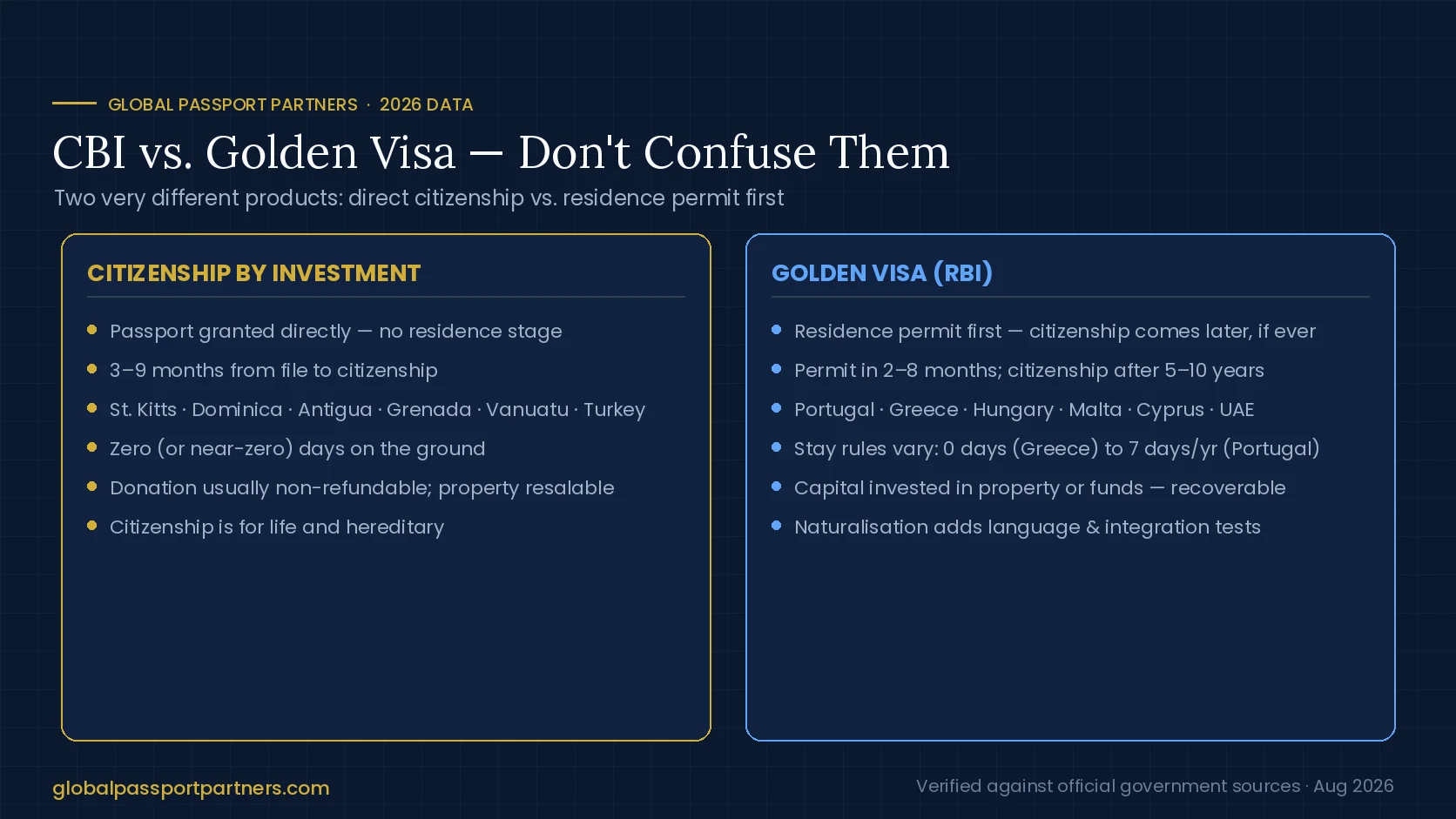
Investment splits into two products people constantly confuse: CBI grants citizenship directly with no residency stage, while Golden Visas (RBI) grant a residence permit first, with citizenship available only after years of legal residence and, usually, a language exam.
For Investors: CBI vs. Golden Visa Warnings
Before wiring a dollar into any investment route, internalise these realities:
- Due diligence decides everything: all reputable programmes run multi-layer background checks. A criminal record, sanctions exposure or undocumented source of funds means refusal — and a refusal in one CBI programme can complicate future applications elsewhere through shared databases.
- Donations are non-refundable; real estate is resalable only after mandatory holding periods (typically 5 years).
- Dependant rules vary enormously — Antigua is widest, others cap children's ages and exclude siblings.
- CBI citizenship does not by itself create tax residency, but relocating afterwards might; sequence the two deliberately.
- Programmes are politically sensitive: prices, rules and even existence can change — the Caribbean's 2024 price floor and Portugal's 2026 law both proved it.
- Caribbean applications legally must be filed through government-licensed agents; nobody can apply directly, and anyone promising 'guaranteed' citizenship is lying to you.
Which Route Fits You?
- European ancestry? Ireland or Italy — no residence, no language test, minimal cost. Start gathering ancestral documents today.
- Budget-conscious and mobile? Paraguay or Argentina — low cost, genuine relocation, basic Spanish required.
- Family seeking relocation to Europe? Greece or Portugal — EU schooling and healthcare; Portugal needs only 7 days a year, Greece needs real integration.
- Investor needing speed? St. Kitts or Dominica — a Caribbean passport in under seven months, fully remote.
- Large family, one application? Antigua & Barbuda — siblings, parents and grandparents included.
- Speed above everything, dual citizenship negotiable? Vanuatu — 1–2 months, eyes open on the restrictions.
Risks to Weigh Before You Apply
Immigration law is not static. Portugal's 2026 reform doubled the qualifying period; Italy's 2025 law cut descent to two generations; the Caribbean's 2024 MoU raised every price floor. Always verify the law in force on your application date — not the blog post you read last year.
Beware anyone selling 'diplomatic passports', instant citizenship or guaranteed approvals: no government guarantees citizenship, decisions are discretionary, and misrepresentation is grounds for refusal and revocation. Incomplete documents — missing apostilles, mismatched names, expired police clearances — remain the leading cause of delay. Citizenship can also carry obligations: tax and reporting consequences (including FATCA for US persons), and in some countries military service. And if your current country restricts dual nationality — India, Japan, Singapore and China among them — acquiring another citizenship has consequences at home that must be planned for first.
The Verdict
The easiest country to get citizenship in 2026 is not a single destination — it is the one that aligns with your ancestry, capital, mobility needs and tolerance for relocation. Argentina rewards those who will live in South America. Ireland and Italy reward those who can prove European roots. The Caribbean and Vanuatu reward investors who need speed. Portugal and Greece reward those who can wait for an EU passport.
Rules change, processing slows, and costs only ever rise. Before committing to any pathway, verify current legislation through official sources — the Irish DFA's Foreign Births Register, Portugal's AIMA, and the St. Kitts, Dominica and Antigua Citizenship by Investment Units — and take advice from licensed professionals. That is exactly what our advisors do every day: a free assessment tells you, in writing, which of these doors your profile actually opens.
Frequently Asked Questions
There is no single easiest country. Argentina offers the fastest naturalisation at two years of residence. Caribbean CBI programmes like Dominica and St. Kitts grant citizenship in months without relocation. Ireland and Italy allow descent-based citizenship with no residency at all. The best choice depends on your ancestry, finances and willingness to relocate.
Vanuatu processes citizenship-by-investment applications in 1–2 months — the fastest in the world. Among the established Caribbean programmes, St. Kitts & Nevis delivers in 3–6 months. Among naturalisation routes, Argentina has the shortest qualifying period at two years of residence.
Ireland is the easiest for anyone with an Irish-born parent or grandparent — no residence, no language test, €278 fee. For investors without ancestry, Portugal's Golden Visa remains the most practical EU pathway at 7 days a year of presence, though the citizenship timeline is now 10 years for most non-EU applicants under the 2026 law.
Yes. Citizenship by investment programmes in the Caribbean (St. Kitts, Dominica, Antigua, Grenada) and Vanuatu require no physical presence. Citizenship by descent in Ireland and Italy also requires no residence — only documented ancestry.
Active CBI programmes include St. Kitts & Nevis, Dominica, Antigua & Barbuda, Grenada, St. Lucia, Vanuatu, Turkey, Nauru and São Tomé & Príncipe. Each has different investment thresholds, due diligence standards and family-inclusion rules — our comparison page tracks all of them with current pricing.
In most cases, yes — Argentina, Ireland, Italy, Portugal, Greece and the Caribbean programmes all permit dual citizenship. Vanuatu is a notable exception for naturalised citizens. Critically, check your own country's law too: India, Japan, Singapore and China do not permit dual nationality, which shapes the entire strategy for citizens of those countries.
Yes — when conducted through official government programmes and licensed authorised agents. Every programme we work with is established in national law and administered by a government citizenship unit. What is illegal is buying documents outside official channels or misrepresenting facts in an application.
No. Approval is always discretionary and subject to due diligence, background checks and the law in force at decision time. Meeting the statutory requirements makes you eligible — it does not make approval automatic. Treat any 'guaranteed citizenship' promise as the red flag it is.